
Yesterday’s Music Sunday was a good reminder of something I sometimes forget in the busyness of leading worship: how grounding it is simply to listen.
We heard a wide range of sounds—handbells, organ and piano, a beautiful solo, even a soprano saxophone weaving its way into the service. And then there was the upbeat, jazz-leaning version of “Go Tell It On the Mountain.” It caught me off guard in the best way. Familiar, but not predictable. Joyful without being overdone. It reminded me that good music doesn’t just repeat what we already know—it helps us hear it again.
As a pastor, music is often my favorite part of worship for a simple reason: it’s usually the one time I’m not responsible for what happens next. I’m not directing, explaining, or transitioning. I’m just one voice—or sometimes no voice at all—among many. In those moments, I feel less like the person up front and more like someone who is simply, yet wonderfully, a part of the congregation. Music has a way of flattening the room, reminding us that worship isn’t something a few people do for others, but something we share.
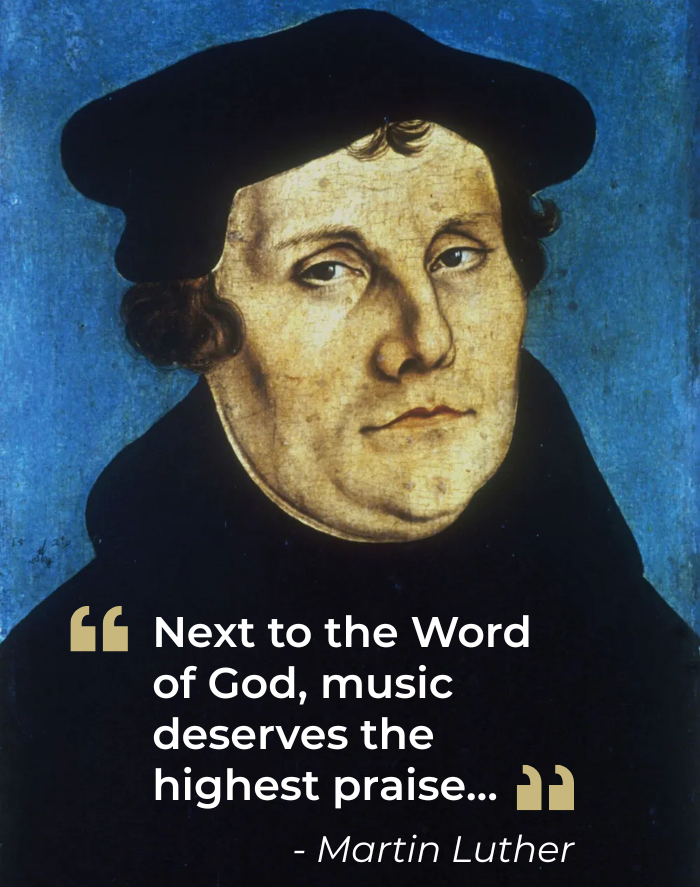
Martin Luther, the founder of the Lutheran Church and a prolific hymn writer, had strong feelings about music. He once wrote, “As long as we live, there is never enough singing.” That’s not sentimentality—it’s a statement about what it means to be human before God. Luther also said, “Next to the Word of God, music deserves the highest praise… the gift of language combined with the gift of song was only given to man… to proclaim the Word of God through music.” In other words, music isn’t filler. It’s proclamation, just like the preaching I do most weeks.
And then there’s his third quote, which is a bit off-color, but honest enough to be worth sharing. Luther wrote, “A person who does not regard music as a marvelous creation of God must be a clodhopper indeed… he should be permitted to hear nothing but the braying of asses and the grunting of hogs.” It’s blunt, even crude—but it leaves no doubt about how seriously he took the role of music in faith and life.
Music Sunday doesn’t happen on its own. It reflects the steady, faithful work that goes on all year long. I’m deeply grateful for our music ministry—our volunteers who give their time and energy, and for our staff, Ford and Jackie, whose leadership, preparation, and care make space for music that serves the church well.
Yesterday wasn’t about performance. It was about participation, attention, and shared life. As I say most weeks, our music ministry shows us that our gifts can and should be shared, and that together, our gifts can do so much more than any one of us could alone. Our music ministry represents the many and diverse gifts present within our faith community and reminds us to share those gifts together.