
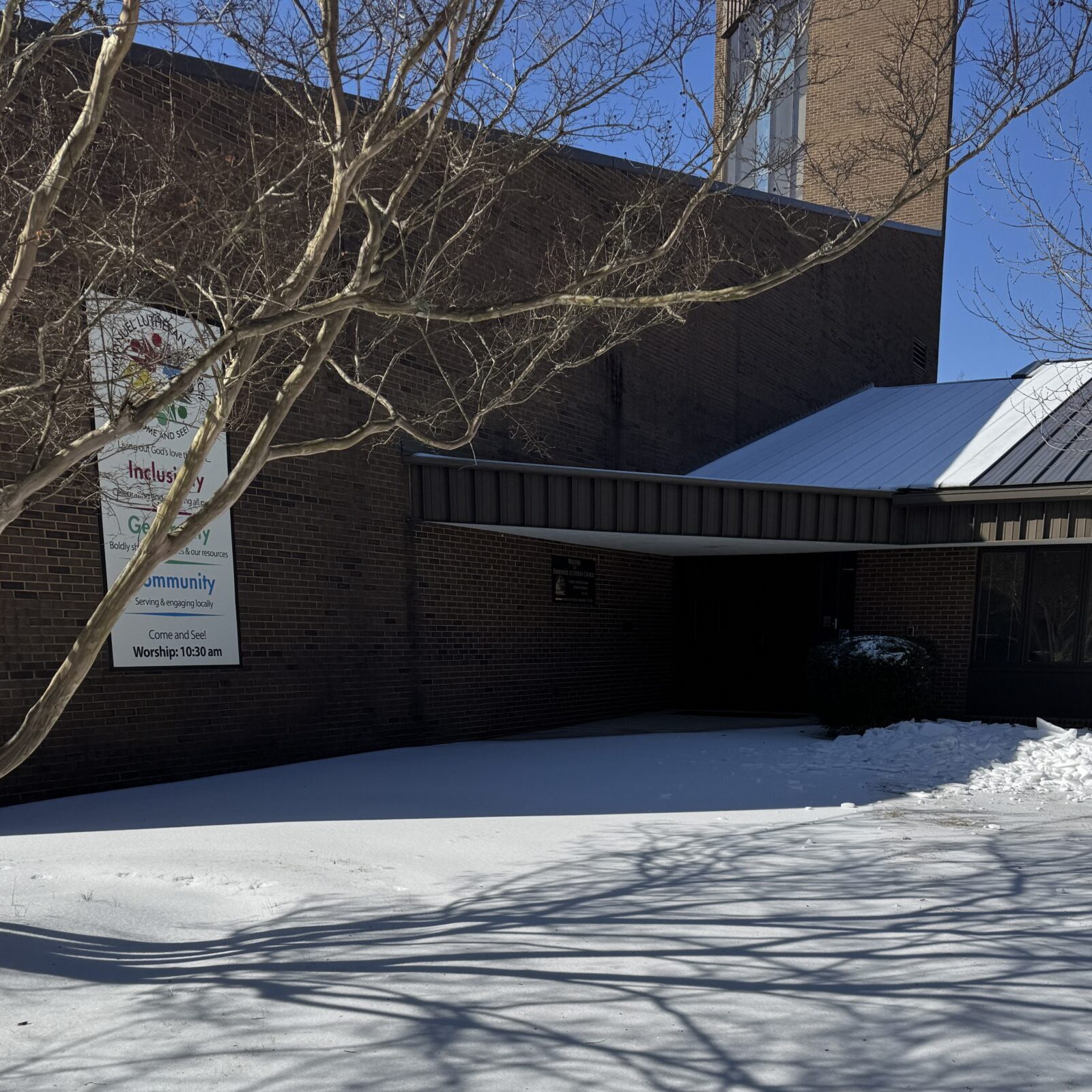
For the second Sunday in a row, winter has made our decision for us. Last week, it was ice—dangerous, treacherous ice. This week it’s snow, more snow than I’ve seen in this area since I was a child, and with these lingering cold temperatures, I’ve barely left my front porch. Neither has one of my two dogs, who has made her opinion about all this quite clear. It was an absolutely beautiful snowstorm, but I’ll admit it was hard to enjoy since it came on the heels of such a frustrating ice event—not to mention that I’ve been home alone while my family is away for work.
And so for the second week in a row, no worship service. The office remains mostly closed, and our carefully planned schedules have been blanketed over by something entirely beyond our control.
It’s frustrating, isn’t it? We long to gather around Word and Sacrament. We miss the familiar rhythms of Sunday morning—the liturgy, the fellowship, the shared prayers. We feel the absence of our sacred assembly, and perhaps we even feel a bit bummed about not being able to worship together as we intended. (Unless it’s just me, but I doubt that!)
But what if this enforced pause reveals something about grace we often forget? What if these snow days are an unexpected sabbath—a kind of rest we wouldn’t have chosen but that reminds us of something essential?
In our hyperconnected, always-productive world, we’ve become remarkably good at conflating our activity with God’s activity. We fill every moment, schedule every hour, and measure our faithfulness by our busyness. Yet here comes the snow, indifferent to our calendars, reminding us of what Luther knew well: God works through means we cannot manufacture or control. We’re not as important as we like to convince ourselves that we are. Grace abounds for us even when we can do absolutely nothing to earn it or manufacture it—because we can’t. But that doesn’t mean our works are not worthwhile.
Luther insisted that God doesn’t need our good works—our neighbor does. And isn’t that exactly what’s happening? While we can’t gather in our sanctuary, the church is discovering what it means to be the body of Christ scattered in the world. We’re checking on neighbors, worshiping in our homes, living out our baptismal vocations in the everyday. Even amid the difficulty—with beloved members of our congregation sick and dying—I have been deeply encouraged by the number of people reaching out to explore how to offer care best. The church is living and active, even when the building is closed.
This is the priesthood of all believers in action—not as a concept we affirm on Sunday, but as the lived reality of Christians caring for one another wherever they are. Your call to love your neighbor doesn’t require a church program or a pastor’s direction. It’s already yours in baptism.
Yes, we long for the means of grace we receive in gathered worship—the proclaimed Word, the shared meal. We will return to these, and soon. But in the meantime, perhaps we’re learning what Luther meant when he said that the Christian life is not about climbing up to God through our efforts, but about God coming down to us—even, or especially, in the midst of ordinary, snowbound days.
The snow will melt. We will gather again at the Lord’s table. But perhaps we’ll return remembering that God’s grace isn’t confined to Sunday mornings or church buildings. It meets us in every place we find ourselves—including snowed in at home.
Until we meet again—stay warm, stay safe, and know that God is at work among us still. In the meantime, I do unfortunately have some work to do today with a snow shovel…
Peace,
Pastor Ethan